| Buy from OSOYOO |
Buy from US |
Buy from UK |
Buy from DE |
Buy from IT |
Buy from FR |
Buy from ES |
Buy from JP |
 |
 |
 |
 |
 |
 |
 |
 |
Overview
Note: The OSOYOO 10.1″ IPS DSI Touchscreen Display requires a driver. Drivers are provided for Raspberry Pi OS and Ubuntu — please select the appropriate tutorial for your OS:
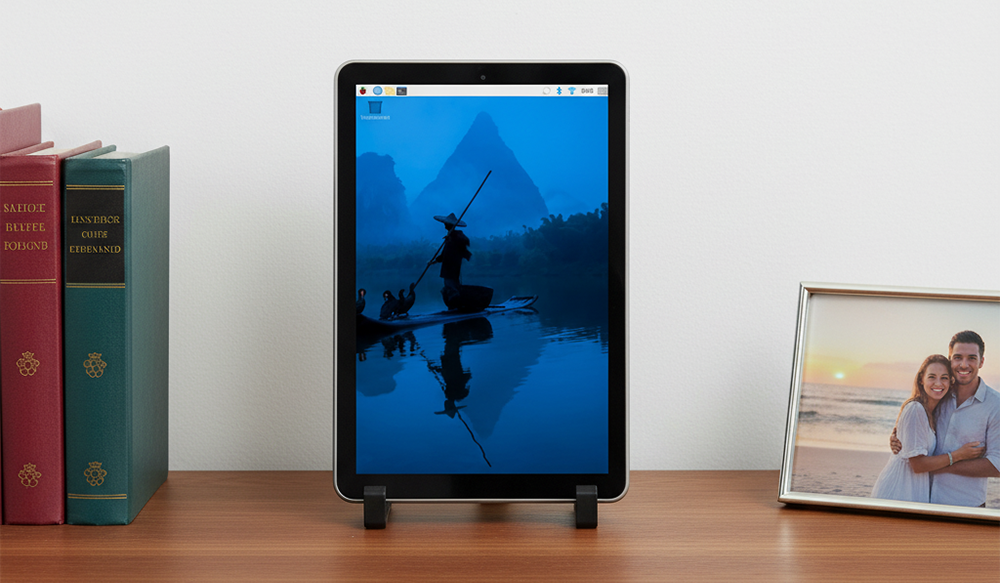
With the OSOYOO 10.1″ IPS DSI Touchscreen Display, experience breathtaking visuals on a vibrant 800×1280 IPS screen with an expansive 170° wide viewing angle, ensuring consistent, accurate colors from almost any perspective. Its durable 6H tempered glass panel provides superior scratch resistance and protection for long-lasting clarity. From its native HD portrait resolution — perfect for developers — to its compatibility with the latest Bookworm OS, every feature is designed to enhance your workflow. The innovative all-in-one design features a protective back housing and a pair of easy-on, easy-off stands, creating a clean, grab-and-go workstation in seconds.
Whether you’re building a mobile server, a custom tablet, or a compact coding station, this display provides the performance, flexibility, and portability you need to bring your ideas to life.

Features
- 10.1-inch DSI touch screen
- IPS display panel with a hardware resolution of 800×1280
- Toughened glass capacitive touch panel with a surface hardness of up to 6H
- Supports driving the LCD directly via the DSI interface of the Raspberry Pi, with a refresh rate of up to 60Hz.
- A driver is required. Installation is easy, and only the latest Bookworm system is supported (Kernel 6.12 and later, released 2025-05-13).
- Supports all Raspberry Pi computers with DSI interfaces (Raspberry Pi 5/4/3/2)
- HIGH-SPEED DSI CONNECTION: Experience a flawless, low-latency display with the direct DSI interface. Supporting both 2-lane and 4-lane configurations, it delivers superior performance and lower power consumption compared to HDMI, freeing up your Pi’s HDMI port for other uses.
- ALL-IN-ONE PORTABLE DESIGN: The OSOYOO 10.1″ IPS DSI monitor transforms your Raspberry Pi into a sleek, portable workstation. The custom-designed, non-detachable back case securely mounts your Pi (models 2/3/4/5), and the tool-free, detachable stand offers sturdy support wherever you go. It’s the ultimate solution for a clutter-free, mobile setup.
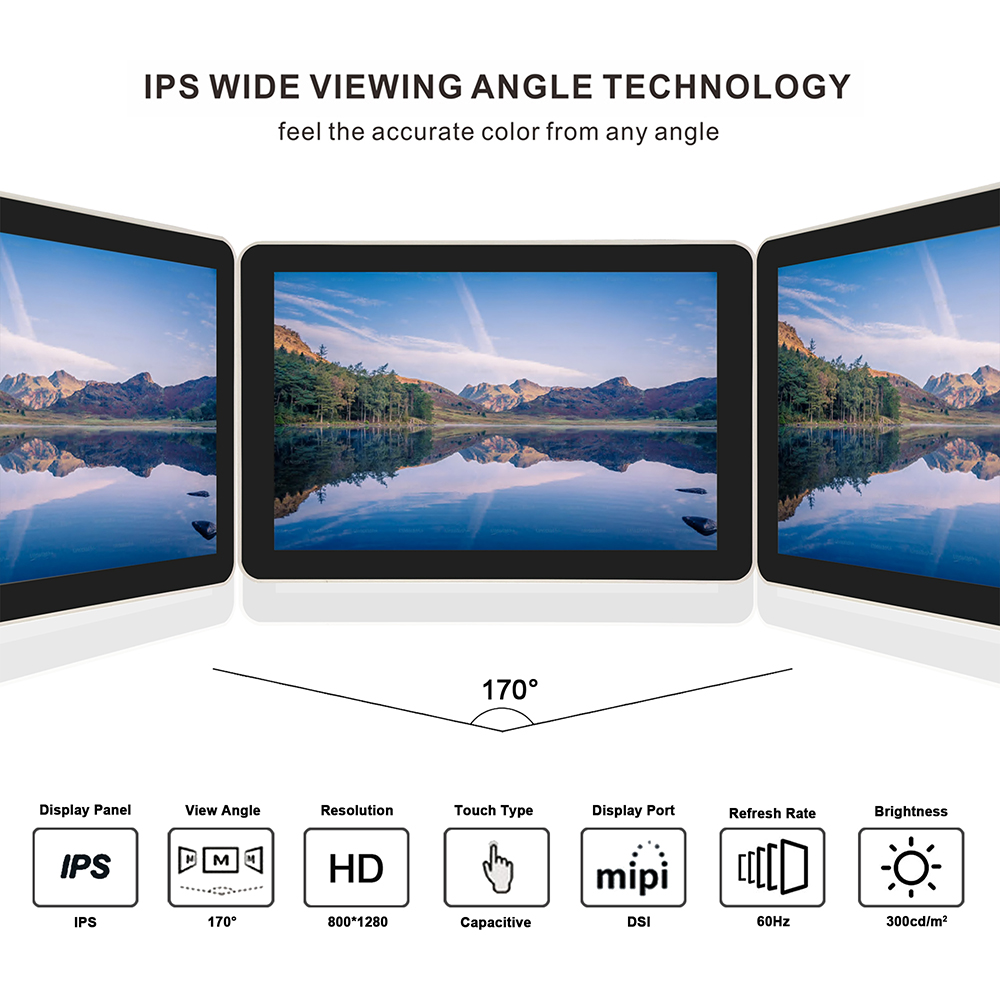
10.1″ IPS screen datasheet:
https://osoyoo.com/picture/10.1DSI/datasheet.pdf
Specifications
| Parameters |
Value |
Unit |
| Input voltage |
5.00 |
V |
| Input current |
0.5 |
A |
| Dot arrangement |
800(H) x3(RGB)x 1280 (V) |
pixels |
| Display mode |
IPS(Normal Black) |
— |
| Viewing Direction |
85/85/85/85 (All) |
° |
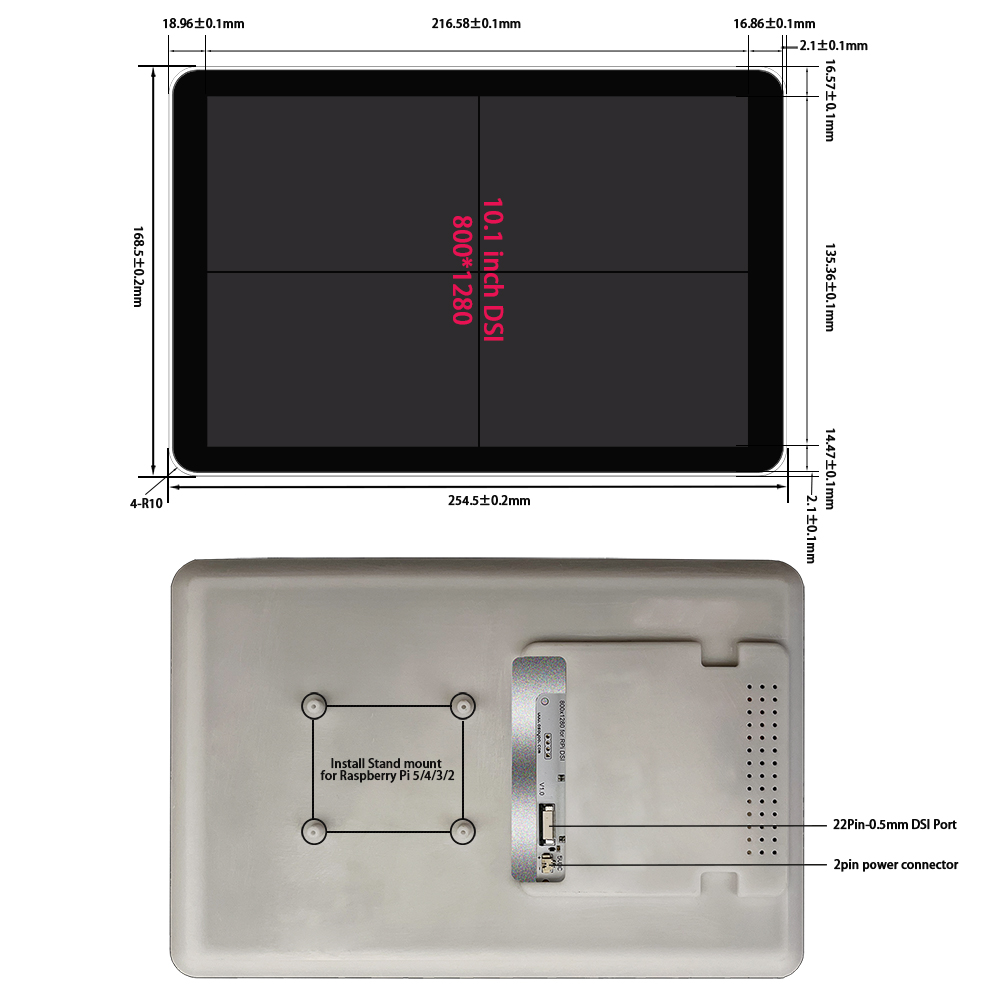
| Module size |
168.5(H) x 254.5(V) x15.5(D) |
mm |
| Active area |
135.36(H) x 216.58 (V) |
mm |
| Interface |
2&4 Lanes MIPI DSI Interface |
— |
| Surface Hardness |
6H |
— |
| Weight |
525 |
g |
| Backlight brightness |
TYP=250 |
nits |
| LCD type |
TFT |
— |
| Panel type |
G+G |
— |
| Operating temperature |
0~50 |
℃ |
| Storage temperature |
-10~70 |
℃ |
Note: Unmarked tolerance: ±0.20
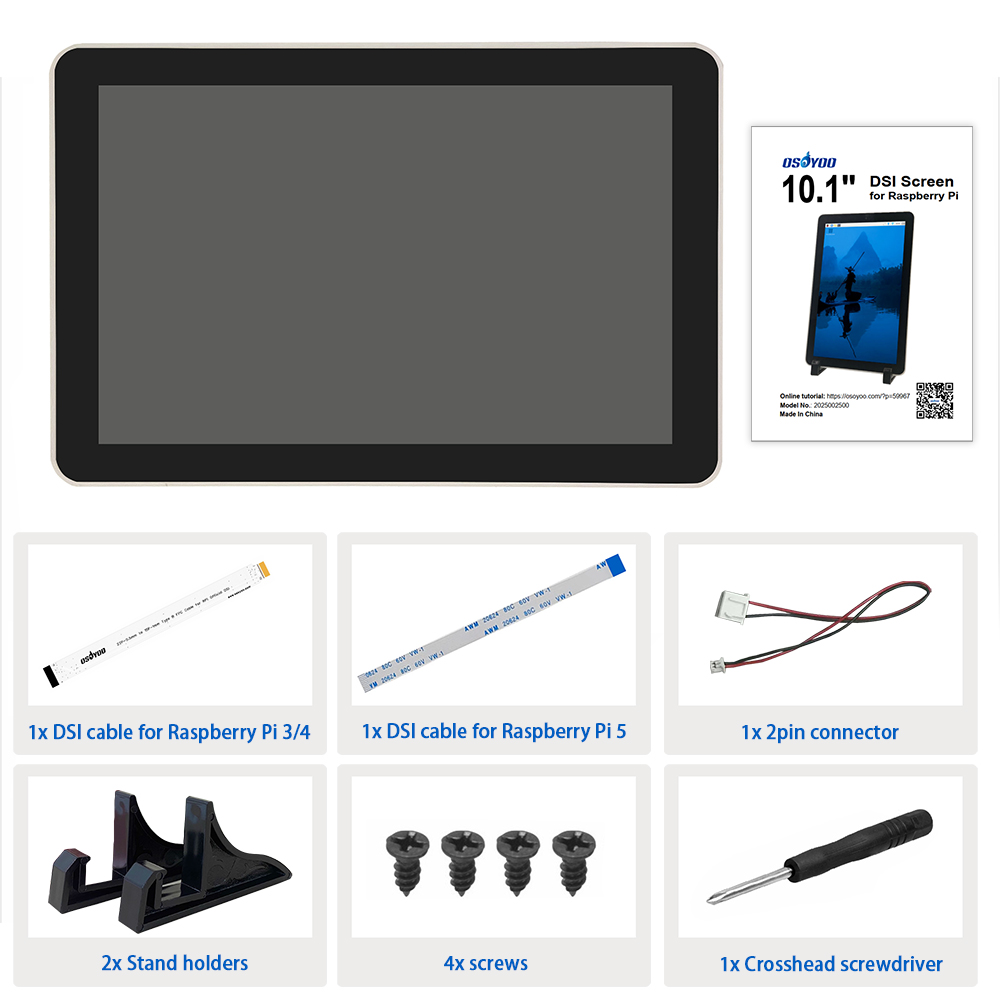
Package Includes
Install
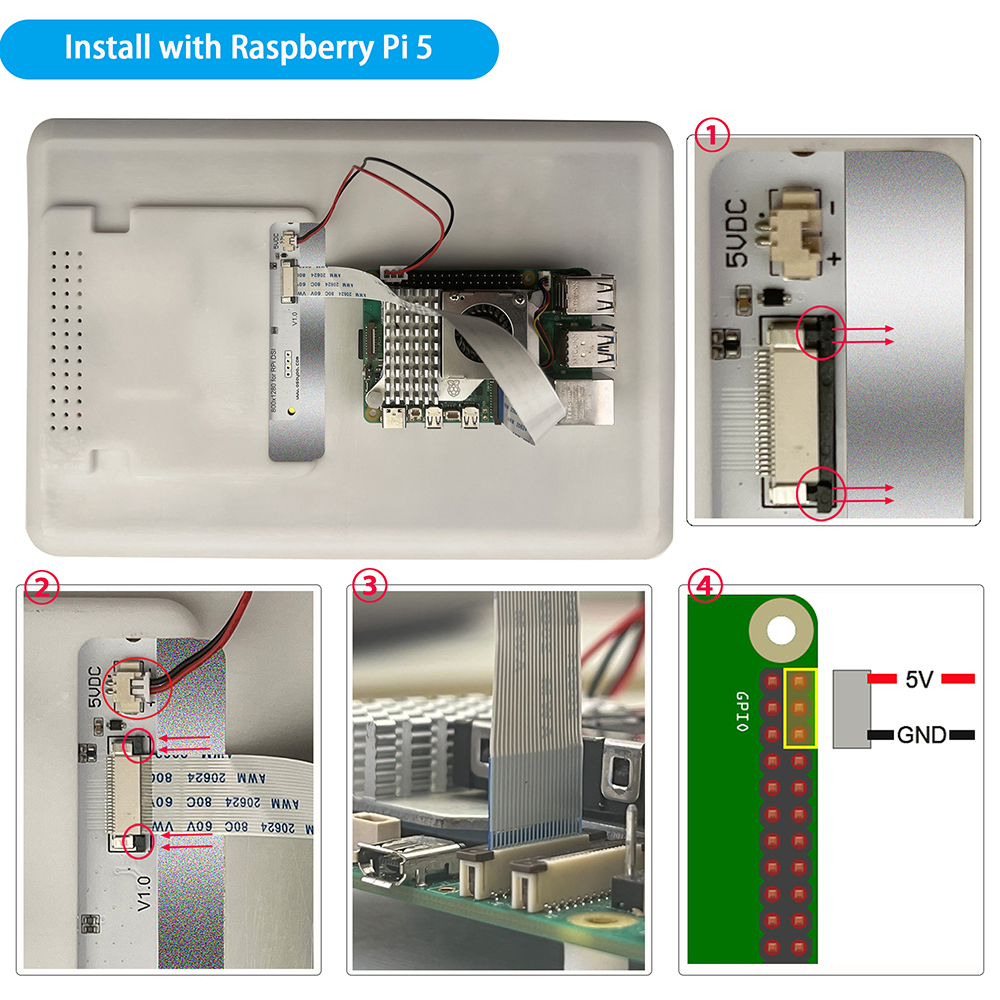
Hardware Connection with Raspberry Pi 5
1. Use the 22-pin 0.5mm to 22-pin 0.5mm DSI cable (for Pi 5) to connect the DSI port of the display to the 22-pin DSI port of the Raspberry Pi motherboard.
2. Use the 2-pin connector to connect the power connector of the display to the 5V GND pin header of the Raspberry Pi motherboard.
3. Secure the Raspberry Pi to the display with M2.5 screws.
Note: Make sure the DSI cable is connected in the correct direction and that 5V power is supplied through the GPIO pins.
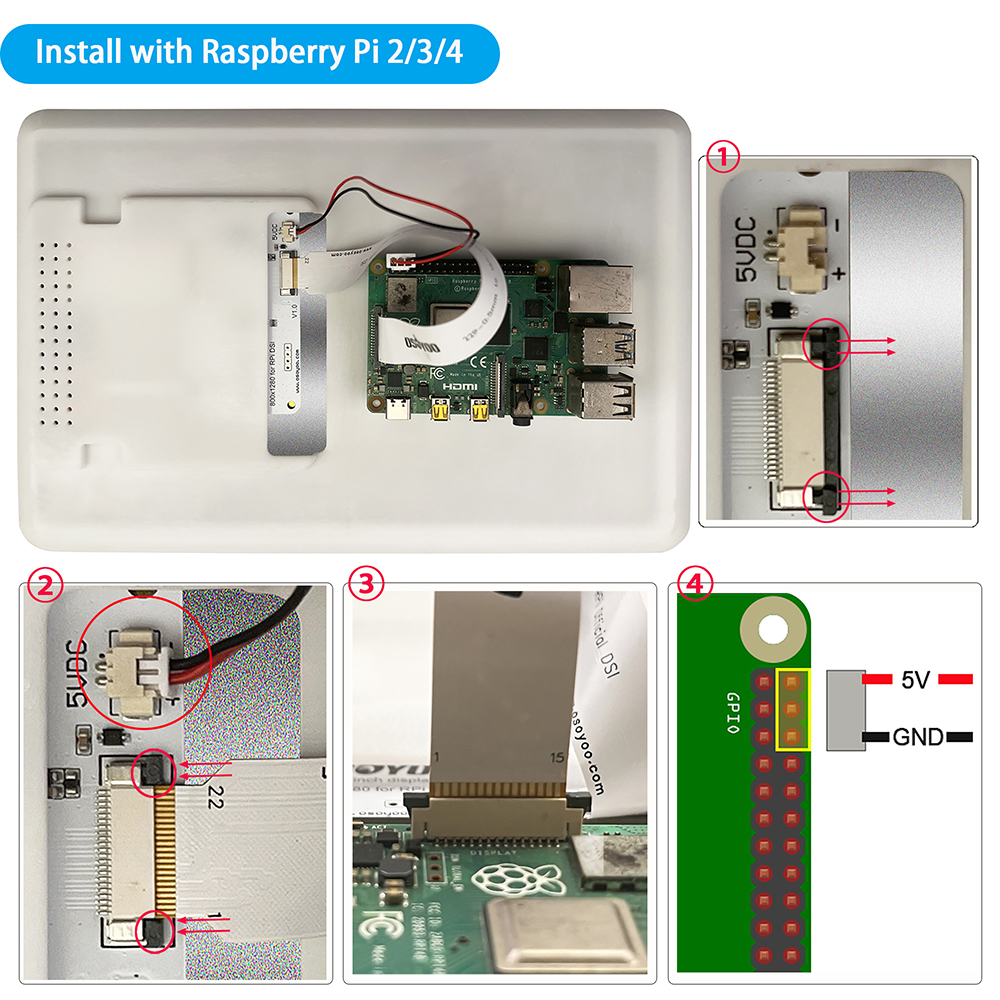
Hardware Connection with Pi 4B/3B+/3B/3A+
1. Use the 15-pin 1mm to 22-pin 0.5mm DSI cable (for Pi 3/4) to connect the DSI port of the display to the 15-pin DSI port of the Raspberry Pi motherboard.
2. Use the 2-pin connector to connect the power connector of the display to the 5V GND pin header of the Raspberry Pi motherboard.
3. Secure the Raspberry Pi to the display with M2.5 screws.
Note: Make sure the DSI cable is connected in the correct direction and that 5V power is supplied through the GPIO pins.
SAFETY INSTRUCTIONS
To avoid malfunction or damage to this product, please observe the following:
• Before connecting the device, shut down your Raspberry Pi computer and disconnect it from external power.
• Input voltages exceeding the maximum or improper operation may cause permanent damage to the device.
• The input current must be ≥ 0.5A; otherwise, it may cause startup failure or display abnormalities, and prolonged abnormal operation may cause permanent damage to the device.
• If the cable becomes detached, pull the locking mechanism forward on the connector, insert the ribbon cable with the metal contacts facing toward you, then push the locking mechanism back into place.
• This device should be operated in a dry environment at 0–50°C.
• Do not expose it to water or moisture, or place it on a conductive surface while in operation.
• Do not expose it to excessive heat from any source.
• Take care not to fold or strain the ribbon cable.
• Take care when screwing in parts. A cross-thread can cause irreparable damage and void the warranty.
• Take care while handling to avoid mechanical or electrical damage to the printed circuit board and connectors.
• Store in a cool, dry location.
• Avoid rapid temperature changes, which can cause moisture to build up inside the device.
• The display surface is fragile and may shatter if dropped or struck.